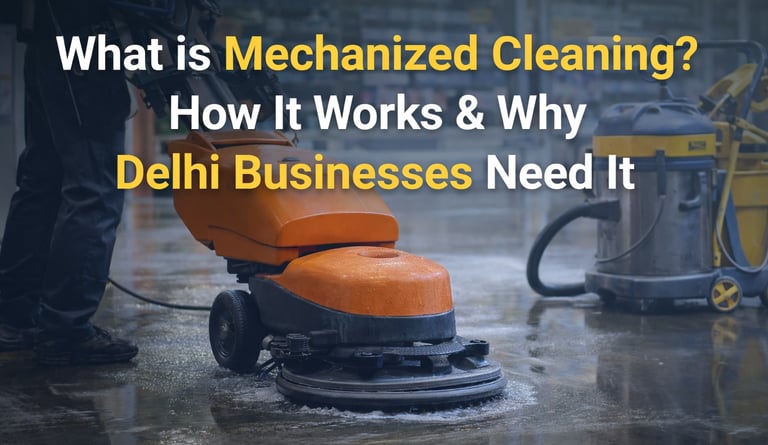
What Is Mechanized Cleaning? How It Works & Why Delhi Businesses Need It
Introduction: • If your facility is still cleaned with mops in 2026, you're losing money. • Traditional cleaning methods are time-consuming, inconsistent, and often fail to meet modern hygiene standards required by businesses today. • What can the readers expect to learn from this blog
3/31/20265 min read
What Is Mechanized Cleaning? How It Works & Why Delhi Businesses Need It?
Introduction:
If your facility is still cleaned with mops in 2026, you're losing money.
Traditional cleaning methods are time-consuming, inconsistent, and often fail to meet modern hygiene standards required by businesses today.
What can the readers expect to learn from this blog
What Is Mechanized Cleaning?
How Mechanized Cleaning Works
Use of Specialized Cleaning Machines
Automated and Consistent Cleaning Process
Reduced Manual Effort and Time
Why Do Delhi Businesses Need Mechanized Cleaning?
Conclusion :
Mechanized cleaning is becoming essential for businesses looking to maintain efficiency and hygiene standards
For businesses looking to upgrade their cleaning processes, getting the right support can make a significant difference
Encourage readers to connect on WhatsApp to discuss their cleaning requirements and get a customized solution
What Is Mechanized Cleaning? How It Works & Why Delhi Businesses Need It?
If your facility is still being cleaned with mops in 2026, you're losing money. That might sound harsh, but it's the truth. Every hour your staff spends pushing a mop around is an hour of productivity slipping away. And at the end of it all, you're not even guaranteed a consistently clean space.
Traditional cleaning methods - mops, buckets, and manual scrubbing - are slow, inconsistent, and increasingly out of step with the hygiene standards that modern businesses are expected to meet. Whether you run a warehouse, a hospital, a mall, or a corporate office in Delhi, the stakes for cleanliness have never been higher.
In this blog, you'll learn exactly what mechanized cleaning is, how it works step by step, and why more and more Delhi businesses are making the switch.
What Is Mechanized Cleaning?
Mechanized cleaning is the use of powered machines and equipment to clean floors, surfaces, and large spaces, instead of relying solely on manual labor. Think of it this way: just like washing machines replaced hand-washing clothes, mechanized cleaning replaces traditional mopping and scrubbing with machines that do the job faster, better, and more consistently.
This includes machines like ride-on scrubber dryers, industrial vacuum cleaners, high-pressure jet cleaners, sweeping machines, and more. These aren't fancy gadgets; they're purpose-built tools designed to handle the kind of cleaning that a mop simply cannot do well.
Mechanized cleaning is used across a wide range of industries - from manufacturing plants and logistics warehouses to hospitals, hotels, shopping malls, and office complexes. Basically, anywhere that has large floor areas or high footfall, mechanized cleaning makes a real difference.
How Mechanized Cleaning Works
Mechanized cleaning works by replacing slow, inconsistent human effort with machines that follow a systematic, repeatable process. The result is a cleaner space, completed in less time, with less manpower.
Here's a closer look at how it all comes together:
1. Use of Specialized Cleaning Machines
The foundation of mechanized cleaning lies in using the right equipment for the right job. Different machines are designed to handle specific cleaning tasks efficiently and with minimal manual effort.
Scrubber dryers clean and dry hard floors in a single pass, ensuring no wet or slippery surfaces are left behind. Ride-on sweepers are ideal for large areas, quickly collecting dust and debris.
Industrial vacuum cleaners tackle fine dust and allergens that traditional methods often miss, while high-pressure washers are used for deep cleaning outdoor spaces and heavily soiled surfaces. The choice of equipment depends on the facility, surface type, and level of dirt, ensuring effective and professional results every time.
2. Automated and Consistent Cleaning Process
One of the biggest problems with manual cleaning is inconsistency. Different workers clean in different ways, some areas get more attention than others, and on busy days, shortcuts are often taken. This leads to uneven results and missed spots.
Machines eliminate this issue by delivering uniform performance every time. A scrubber dryer, for instance, applies consistent water flow, brush pressure, and suction across the entire floor, ensuring no variation due to fatigue or human error.
This level of consistency is critical for industries like food processing, pharmaceuticals, and healthcare, where hygiene standards must be strictly maintained. Modern mechanized cleaning systems can also run on scheduled cycles, ensuring timely and reliable cleaning without constant supervision.
3. Reduced Manual Effort and Time
Let’s talk numbers for a second. A worker manually mopping a 10,000 sq. ft. floor might take 3–4 hours to complete the job. In comparison, a ride-on scrubber dryer can cover the same area in under 45 minutes, and usually with more consistent and thorough results.
This isn’t just about saving time; it directly impacts costs. You reduce labor hours, minimise water usage, and cut down on cleaning chemical waste. Faster cleaning also means your facility is back in use much sooner, without long interruptions.
For businesses in Delhi, where operational efficiency directly affects the bottom line, this matters a lot. Less downtime means more productive hours, smoother workflows, and better overall utilisation of your space.
Why Do Delhi Businesses Need Mechanized Cleaning?
Delhi is one of the busiest, most densely populated cities in the world. Its businesses deal with high footfall, heavy dust and pollution, and increasingly strict hygiene expectations from customers and regulatory bodies alike.
Here's why mechanized cleaning is becoming a must-have, not a nice-to-have, for Delhi businesses:
Dust and pollution levels are uniquely high: Delhi's air quality means dust settles fast and settles everywhere. Manual cleaning can't keep up. Mechanized equipment, especially industrial vacuums and sweepers, is built to handle this kind of load daily.
Large facilities need scalable solutions: Whether it's a sprawling warehouse in Okhla, a logistics hub in Mundka, or a commercial complex in Connaught Place, large spaces simply can't be cleaned effectively with manual labor alone. Machines scale up to the size of the job.
Hygiene standards are getting stricter: From food businesses to hospitals to corporate offices, the bar for cleanliness keeps rising. Clients, customers, and inspectors all expect more. Mechanized cleaning helps businesses meet those standards reliably and document that they're doing so.
Labor reliability is a real challenge: Managing a large manual cleaning team comes with its own headaches - absenteeism, high turnover, inconsistent training. A mechanized cleaning setup reduces dependence on large teams and delivers more predictable results.
It's cost-effective in the long run: Yes, mechanized cleaning services may cost more upfront compared to hiring cheap manual labor. But when you factor in the time savings, the reduced water and chemical usage, and the consistency of output, it almost always works out cheaper over time.
Conclusion
Mechanized cleaning isn't a luxury anymore; it's fast becoming the baseline for businesses that take hygiene and efficiency seriously. If you're still relying on traditional cleaning methods, you're likely spending more than you need to, getting less consistent results, and falling behind the hygiene standards your clients, customers, and regulators expect.
For Delhi businesses especially, the combination of high pollution, large facilities, and rising hygiene expectations makes the case for mechanized cleaning even stronger.
If you're thinking about upgrading your cleaning setup, the right partner can make all the difference - one who understands your facility, recommends the right equipment, and delivers consistent results.
Ready to find out what the right mechanized cleaning solution looks like for your business? Connect on WhatsApp and share your requirements, you'll get a customized plan built around your facility and budget.
Frequently Asked Questions
1. Is mechanized cleaning only suitable for large facilities?
No. Compact machines make mechanized cleaning effective for offices, restaurants, clinics, and retail stores. The key is selecting equipment that matches your space size and cleaning requirements.
2. Will mechanized cleaning damage my flooring?
No, when done properly. It is often gentler than manual scrubbing, as professionals use the correct machine settings and cleaning solutions suited to different floor types.
3. How often should mechanized cleaning be done?
It depends on footfall and facility type. High-traffic spaces may need daily cleaning, while offices may require it a few times weekly based on usage and hygiene standards.
4. Do I need to shut down my facility?
No. Cleaning can be scheduled during off-hours or done in phases, allowing operations to continue smoothly without major disruptions to your business activities.
5. Is mechanized cleaning environmentally friendly?
Yes. Modern machines use less water and fewer chemicals. Many are battery-operated, reducing emissions and making them a more sustainable cleaning option, especially in urban environments.
Contact
Reliable workforce solutions since 1991
Phone
+91 9312077982
© 2026. All rights reserved.
+91 9999261934